
How to Check Criminal History in Brush
Choose a source by record type. Brush police records are requested on the city's criminal-justice form. Municipal citations, pleas, and judgments go to the city court. A custodial event may create a Morgan County detention entry, while a state charge creates a file at Morgan Combined Court. The Colorado Bureau of Investigation provides Colorado-wide name and fingerprint routes, but it does not replace a local narrative or court file.
Use this order:
- Request the narrative, traffic report, or other named record from Brush Police.
- Give the case number, incident date, type, and identity details when known.
- Contact Brush Municipal Court for a city citation, plea, trial event, judgment, or payment record.
- Check Morgan County detention and Morgan Combined Court if custody or state charges followed.
- Use CBI for the appropriate statewide history, then verify any unclear event with its source office.
A name alone can point to several people or several kinds of files. Dates, case numbers, and the agency that handled the event make a Brush criminal record search far more reliable.
Brush Police Record Choices
The Brush request form makes a useful first distinction. A police report means the incident narrative. A traffic report concerns a crash or traffic event. The “Other” choice needs a written description of the material sought. Those options prevent a requester from asking for a broad “criminal history” when the actual need is one known report.
- Police Report
- The narrative and releasable attachments created by Brush officers for an incident.
- Traffic Report
- The city police record tied to a traffic event rather than a court disposition.
- Other
- A specifically described criminal-justice record that does not fit the two listed choices.
- Case Report Number
- The local identifier that can help staff locate the correct event.
The form also asks for incident date and type. Supplying both reduces the risk that a common name produces the wrong file.
The Brush Police Department
Brush Police Department operates from the city complex at 600 Edison Street, Brush, CO 80723. The city general number is 970-842-5001. Chief Brandon Flecksteiner can be reached at 970-842-5074 or bflecksteiner@brushpolice.org. The department's official page links its fee schedule, records request, local codes, registry search, citizen academy, and emergency-notification information.
The Brush Police Department page identifies the city source for reports created by its officers.

That city source should be used before a county office is asked for a narrative it did not create.
Brush did not publish a city jail or booking portal in the reviewed material. Police reports remain local, but custody questions move to Morgan County's official jail route when an arrest resulted in detention.
Brush Criminal Justice Request Form
The online form is titled “Request to Release Criminal Justice Records.” It asks for the requester's name, date of birth, address, city, state, ZIP code, phone, email, and identification details. An attorney registration number can be supplied when it applies. The record portion offers a police narrative, traffic report, or another described item, plus the case number and incident date and type. A typed signature completes the request.
| Requester | Name, date of birth, address, phone, email, and ID details |
|---|---|
| Record type | Police narrative, traffic report, or a described other record |
| Event locator | Case report number, incident date, and incident type |
| Completion | Typed signature and submission to the police custodian |
| Release method | Staff call when the approved record is ready for pickup |
The official Brush police records request displays the form and its legal notice.
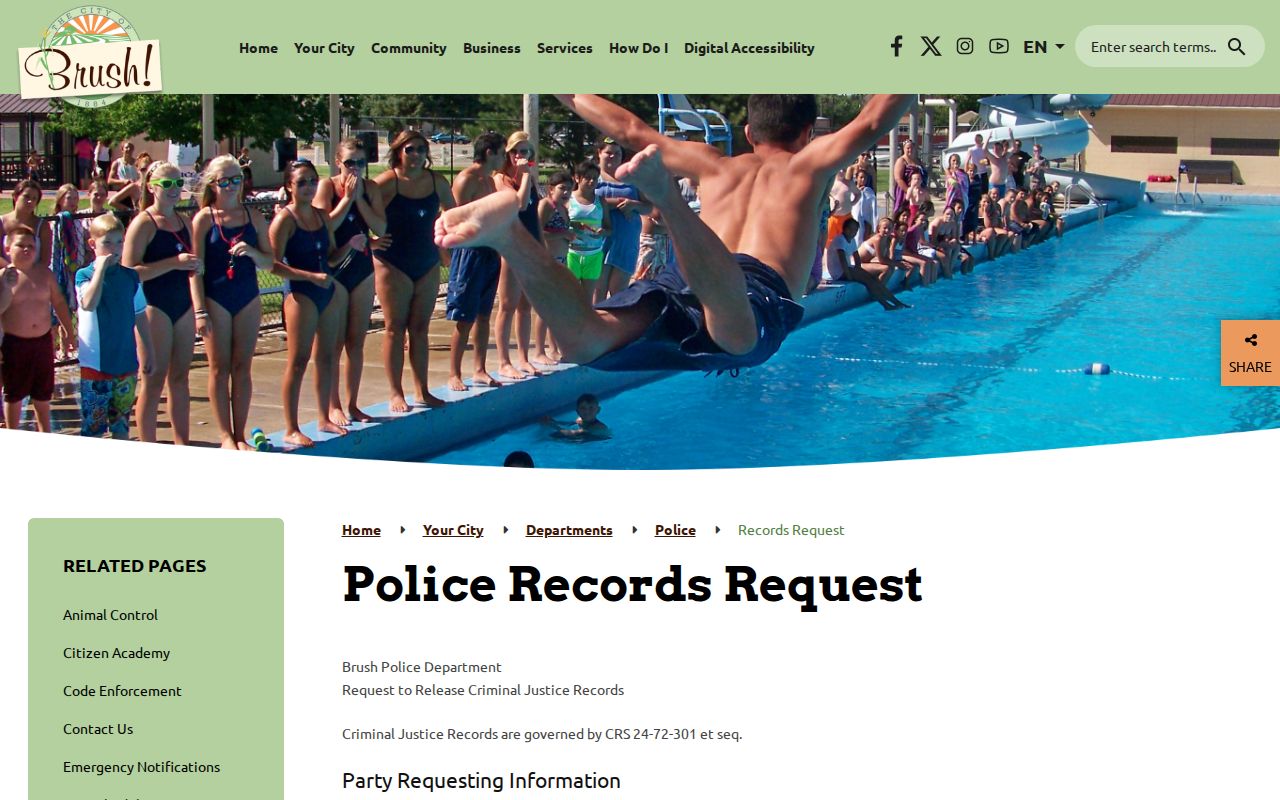
The specific form matters because Brush routes police material away from its general city-record request.
Arrests and Bookings in Brush
A Brush arrest can create at least three different records. Brush Police keeps the incident or arrest narrative. Morgan County detention creates any county booking and custody entry. A municipal or state court later creates the case file and outcome. No Brush jail or city booking portal was identified, so the county destination is a structural inference that should be confirmed with the agencies for a particular person.
Begin with Brush when the question concerns what city officers reported. Use Morgan County detention or VINELink for current custody. Then identify the filing court. A city-code or municipal traffic case remains in Brush Municipal Court. State criminal charges are filed in Morgan Combined Court. The allegation at arrest can be changed or dismissed, so the court's disposition is the sound outcome source.
Note: A Brush police narrative records an allegation and investigation; it does not establish guilt.
When Brush Records Become Ready
The city form says the custodian has three business days and will call when the record is ready for pickup. Copies cost $0.25 per page, and other charges may apply. That language describes ordinary processing, not a guarantee that all requested content will be released without review. Redaction, legal restrictions, or the size of a request can affect the result.
Brush also has a general Colorado Open Records Act form for non-police city material. It asks for contact information and a detailed description. A substantially large general request can extend to seven working days with notice and a cost estimate under C.R.S. § 24-72-203. Police criminal-justice material uses the police form instead. Choosing the wrong form can add delay because the city must reroute the request.
The police form also cites C.R.S. § 24-72-305.3 and warns against prohibited direct pecuniary solicitation. That warning is part of the lawful-use affirmation, not a substitute for the custodian's disclosure review.
Brush Municipal Court Records
Brush Municipal Court hears Brush Municipal Code matters and municipal traffic tickets. It is a court of record, which means it preserves a formal record for appeal to District Court. That status does not turn its municipal file into a Morgan Combined Court file. The city clerk remains the first contact for the citation, plea, minute entry, judgment, or payment history.
| Court Name | Brush Municipal Court |
|---|---|
| Case Types Heard | Brush Municipal Code and municipal traffic cases |
| Case Lookup Channel | Court clerk or counter; no public name-search portal was identified |
| What the Record Shows | Arraignment, plea, trial setting, judgment, fine, and approved payment terms as applicable |
| Copies & Fees | Confirm record-copy terms with the municipal clerk |
Presiding Judge Stephen Jones and alternate judge Dennis Brandenburg serve the court. A person seeking a live case status should contact the clerk because no general public livestream or case-search database was verified.
Brush Court of Record Rules
At arraignment, the judge advises the person of rights and takes a guilty, no-contest, or not-guilty plea. A not-guilty plea leads toward a court trial. When a case is eligible for a jury, the written jury demand and $25 fee must be submitted within 20 days of the plea. Missing that deadline can affect the available trial path, so the date and filing should be confirmed with the clerk.
The official Brush Municipal Court page lays out those plea and trial rules.
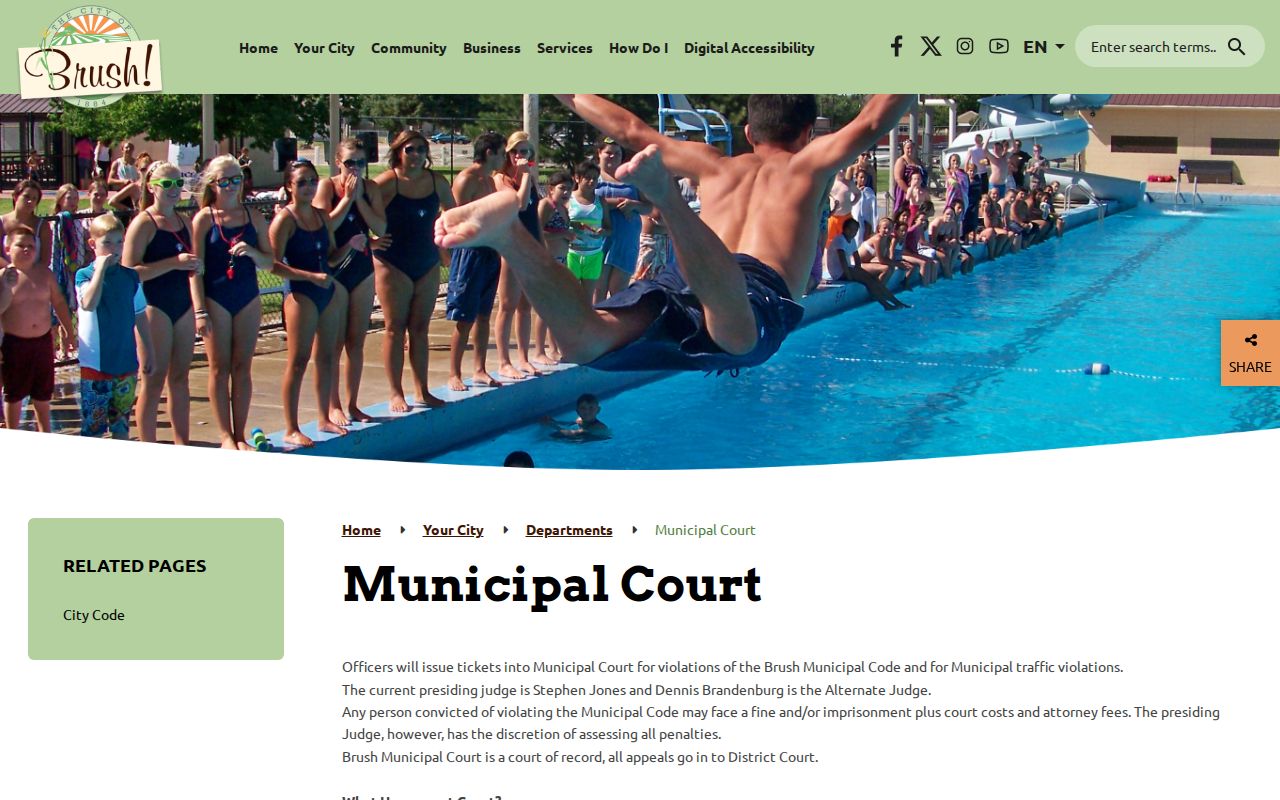
The court page is also the source for current local payment and appearance instructions, which are more useful than relying on an old citation explanation.
Brush Court Payment Arrangements
Fines and costs are due at court unless the judge approves another arrangement. A person who cannot pay that day can apply for a Stay of Execution. When an approved balance is not paid on court day, the published rules state that a $25 stay fee applies. Unpaid balances can lead to sanctions or collections.
A stay is not automatic. The person must use the court's process and obtain approval. Keep the written terms and proof of each payment. If the record later appears to show noncompliance, those documents help the clerk identify what was ordered and what was paid.
This payment record is a municipal court document. Brush Police does not decide the court balance, and Morgan County detention is not the source for the judgment. That clean custody split is central to any Brush criminal history check.
Where Brush Records End Up
Brush Police creates the first city report. Municipal allegations remain with Brush Municipal Court. If the district attorney files a Colorado criminal charge, Morgan Combined Court creates the state case file. A custodial event can add a Morgan County detention entry. Fingerprint-supported arrest cycles and reported dispositions can flow to the Colorado Bureau of Investigation.
Record flow: Brush Police Department › Brush Municipal Court or Morgan Combined Court › Colorado Bureau of Investigation
Each step answers a different question. Police material describes the event. Booking data describes intake and custody. Court files show what was charged and how the matter ended. CBI history summarizes reported Colorado events. When one source lacks the disposition, move to the court rather than assuming the arrest charge remained unchanged.
Trace a Brush Case Outcome
First read the citation or report for the issuing agency and court. Contact Brush Municipal Court when the document cites a city ordinance or municipal traffic matter. Use Morgan Combined Court when a state case number or district attorney filing is involved. The statewide docket can help find a scheduled Morgan hearing, but it is not a full document database.
For a Morgan state file, request a register of actions for the event sequence and a disposition or sentence order for the result. A complaint or information shows filed allegations. These papers are not interchangeable. A disappearance from the current hearing list does not prove dismissal.
If CBI history later lacks the outcome, preserve the court order and use the official correction or update process. The originating arrest record, court file, and repository entry must be compared by identifiers, not treated as one perfect database.
Public Access Rules for Brush Records
Brush Police decides access to the criminal-justice material it keeps under Colorado law. It may redact protected personal data, victim details, juvenile information, or active investigative content. Brush Municipal Court applies court access rules to its files. The general city custodian uses the Colorado Open Records Act for non-police municipal records. A clear request should identify the precise document and avoid asking one office to produce a different custodian's records.
Key Statutes:
Colorado Criminal Justice Records Act, C.R.S. §§ 24-72-301 through 309 - governs access decisions for criminal-justice records held by police custodians.
Chief Justice Directive 05-01 and P.A.I.R.R. - set access and security rules for Colorado court records.
C.R.S. §§ 24-72-703 through 710 - cover adult sealing and limits on ordinary public access to qualifying records.
Sealed and protected records will not appear like ordinary public files. Verify any uncertain result with the Brush office that created it and the court that entered the final order.